
 Back to Work
Stratis
Helping lease teams turn document changes into decisions the next person can trust.


The full story5 min read
A clearer route from amendment to action
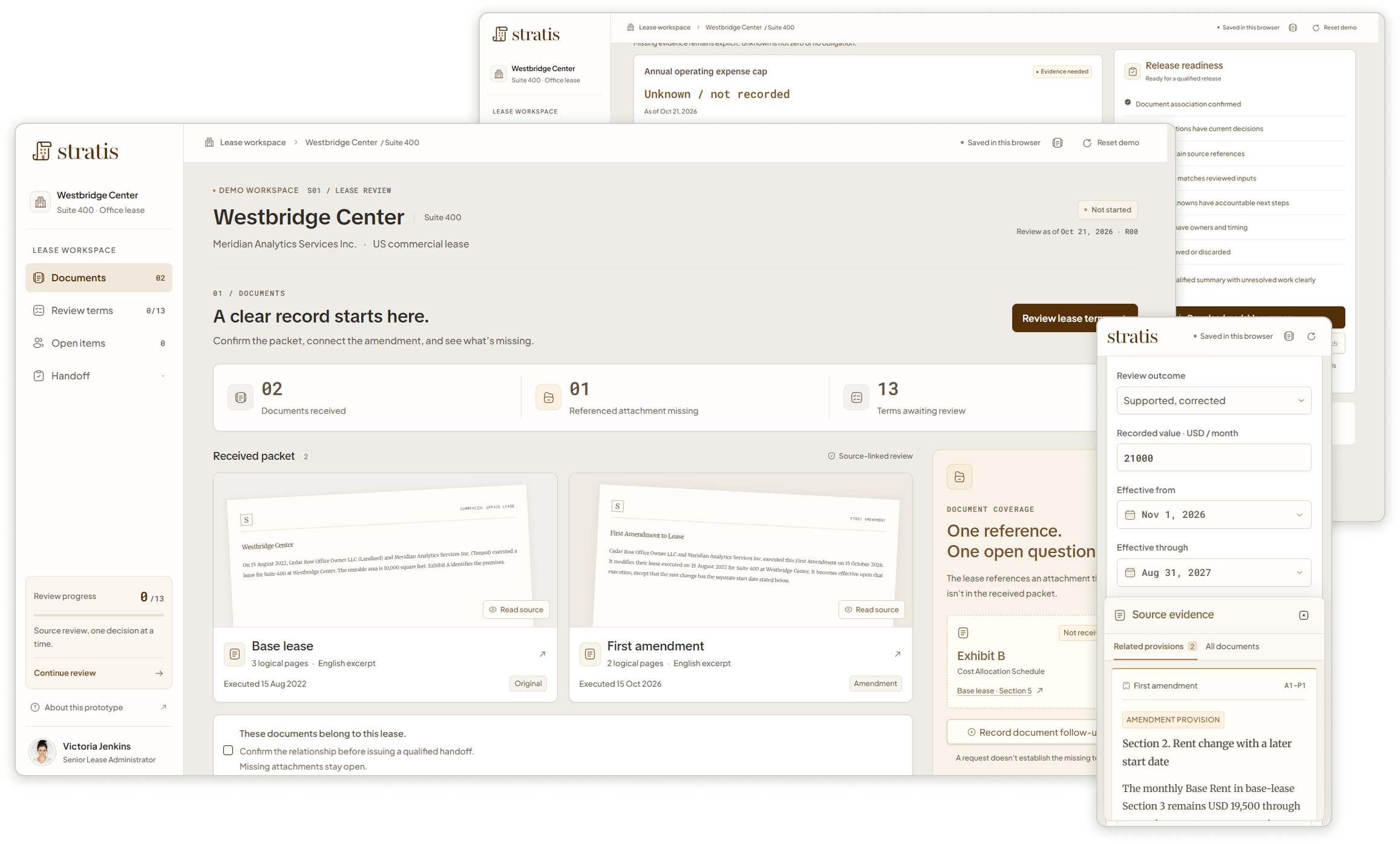
A changed lease can affect next month’s billing, a renewal deadline, and several colleagues’ work. Stratis explores how a US commercial property owner’s lease team can review those changes and pass on a dependable record.
- Business requirement
- Keep the governing source, effective dates, unresolved evidence, and next owner together before information reaches Accounting.
- My role
- I led scope, practitioner research, workflow, interaction design, original branding, and prototype implementation with AI assistance.
- Delivered
- A working review-to-handoff prototype. Live extraction and integrations remain outside this slice.
Two practitioners, three design priorities
I narrowed a broad real estate AI concept to amendment review and accountable handoff. Extraction alone would leave the team to reconcile sources, interpret conditions, and chase missing information.
I ran two moderated browser sessions with practitioners at different US owner/operators: a senior reviewer and a junior preparer. They used a synthetic lease packet containing deliberately flawed suggestions.
| What the accounts revealed | What I changed |
|---|---|
| Both raised unclear status meanings. | Separate a saved decision from verified evidence and finished follow-up. |
| Both raised interrupted source access. | Keep relevant clauses beside the editor; use a drawer on narrow screens. |
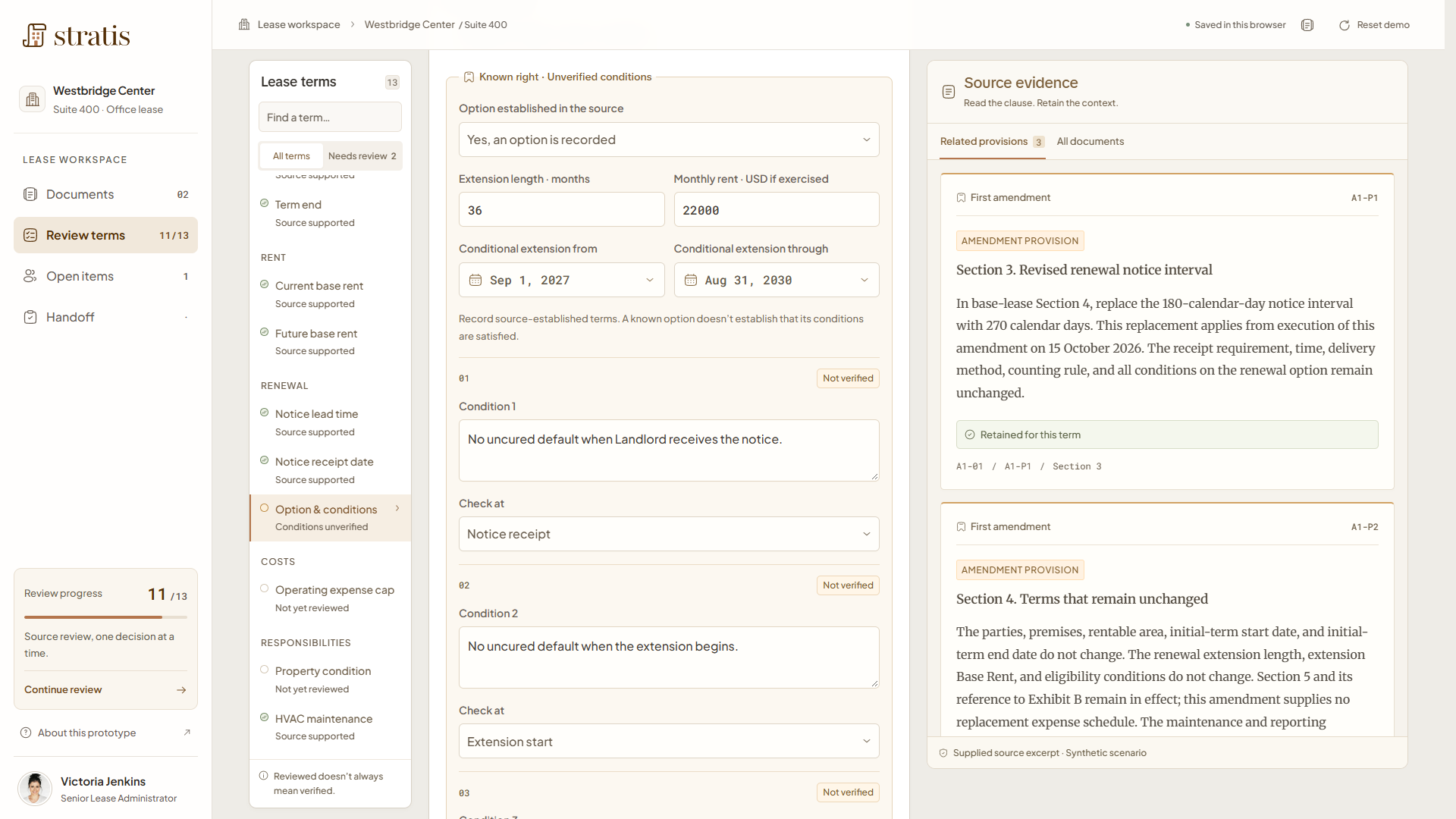
| Both raised conditional-rights concerns. | Store known option terms separately from unverified eligibility. |
Four destinations, one accountable record
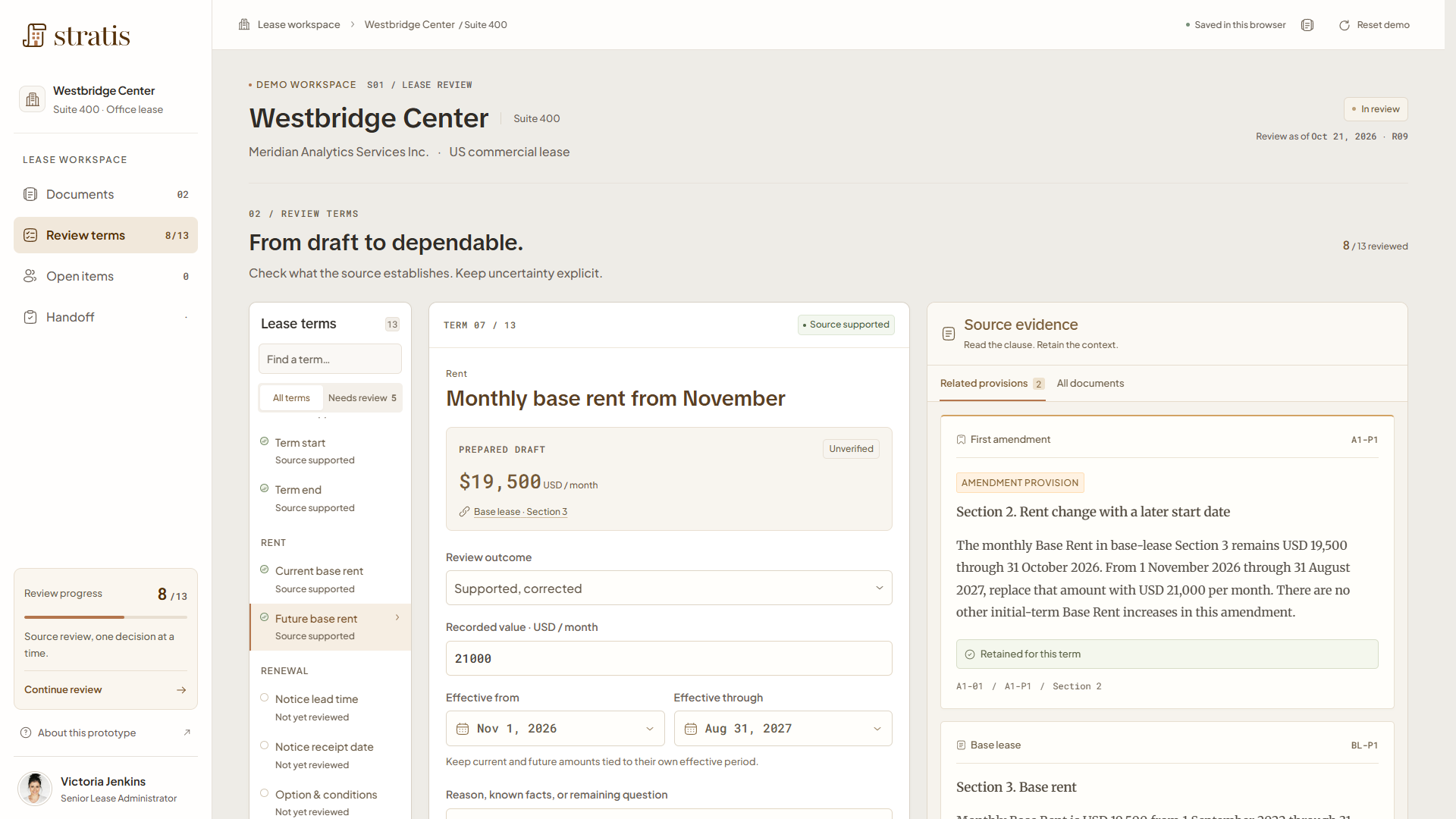
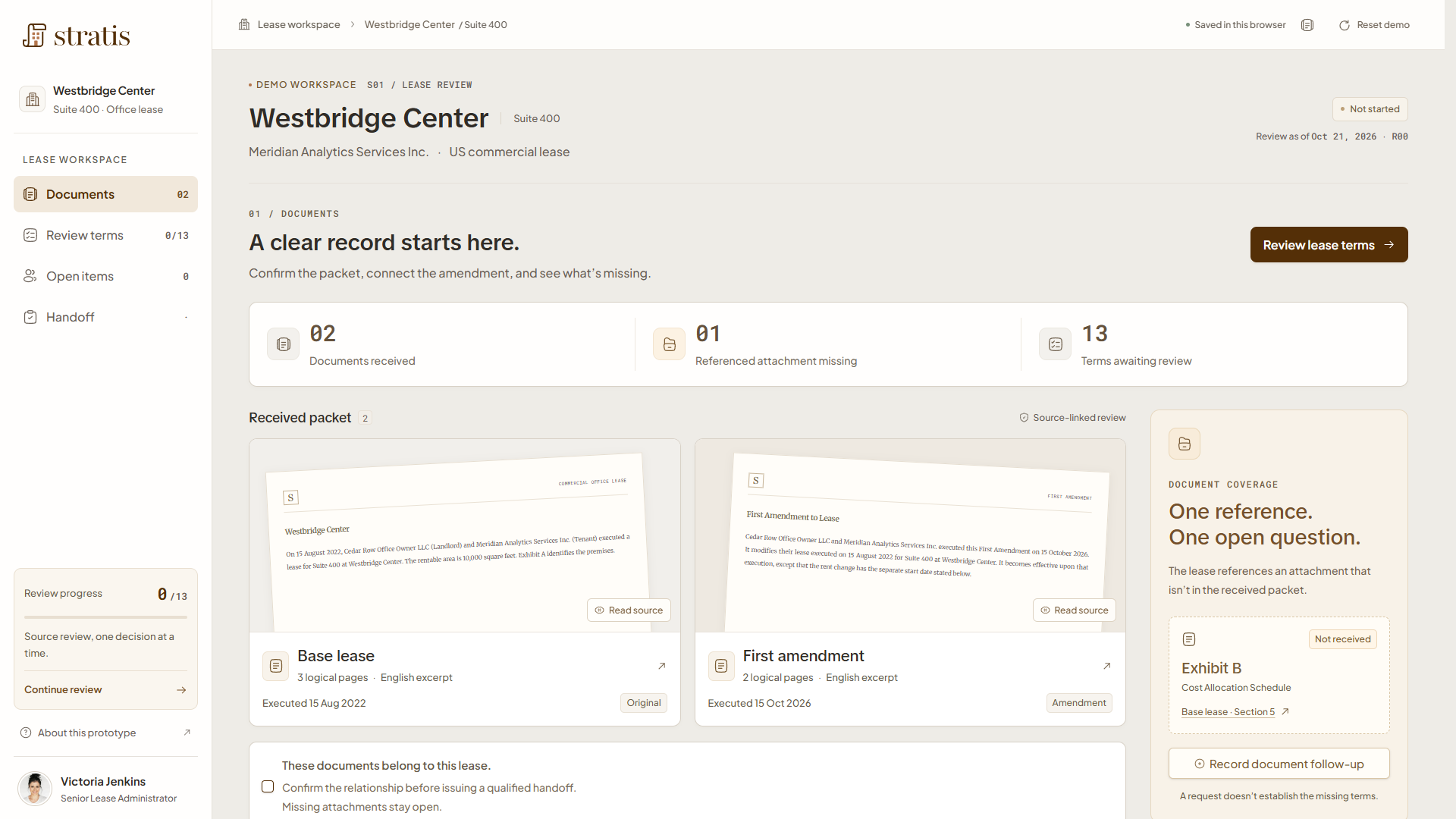
The business requirement became four connected workspaces. Reviewers can save useful progress while missing evidence remains open.
flowchart LR
  accTitle: Amendment review workflow
  accDescr: Confirm document coverage, review terms against sources, assign unresolved work, and issue a qualified handoff.
  A["01. Documents<br/>Confirm coverage"] --> B["02. Review terms<br/>Decide with sources"]
  B --> C["03. Open items<br/>Assign the next action"]
C --> D["04. Handoff<br/>Issue a reviewed record"]- Documents: establish which lease and amendments belong together; flag missing references.
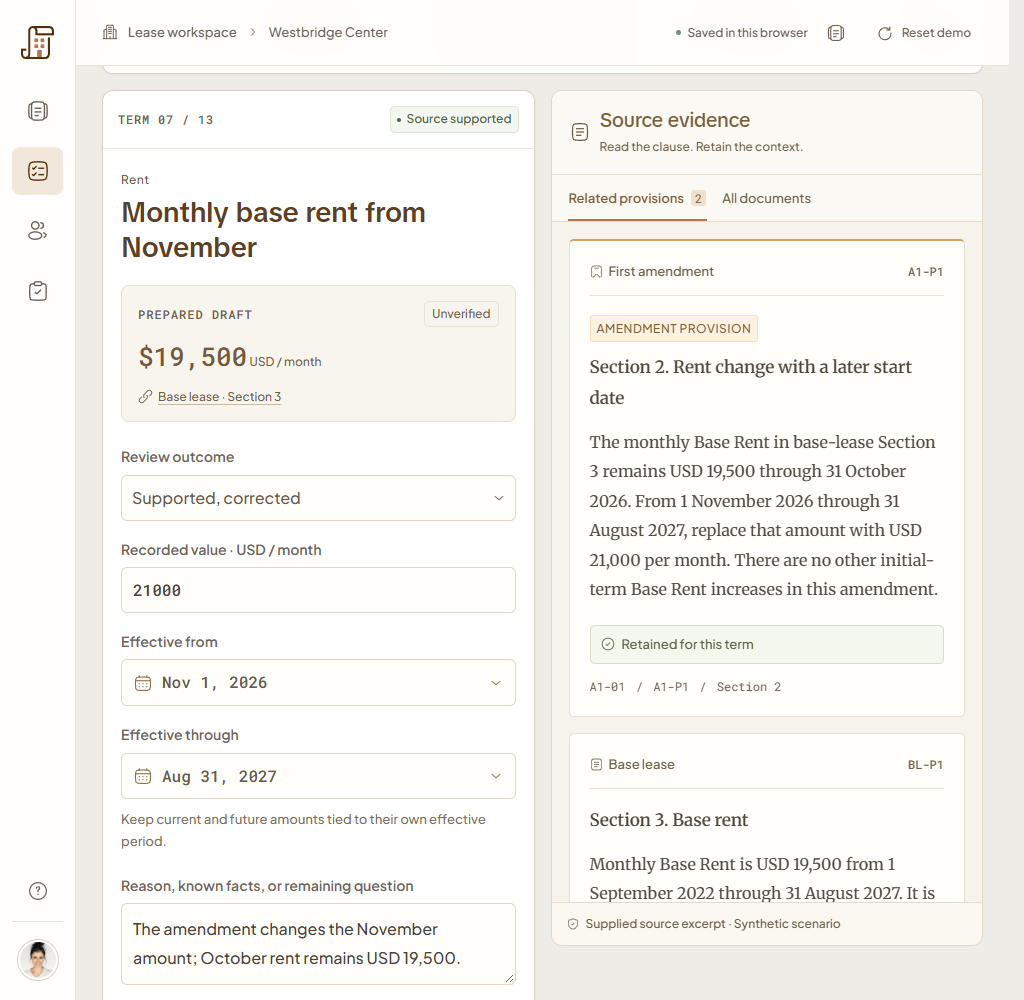
- Review terms: record the supported value, applicable period, and source.
- Open items: keep the question, owner, and required next action together.
- Handoff: check dependencies and acknowledge the record’s qualified scope before export.
Three decisions that shaped the product
01 / Preserve the meaning of “done”
Risk: a completed review action could look like full approval. I separated decision, evidence, and work progress, then made release readiness depend on all three.
flowchart LR
  accTitle: Qualified handoff state model
  accDescr: Saved decisions, evidence limits, and owned follow-up all contribute to a qualified handoff. Saving a decision alone does not verify evidence.
  A["Decision<br/>What was saved"] --> D["Qualified handoff<br/>Scope and limits retained"]
  B["Evidence<br/>Known or unresolved"] --> D
  C["Follow-up<br/>Owner and next action"] --> D
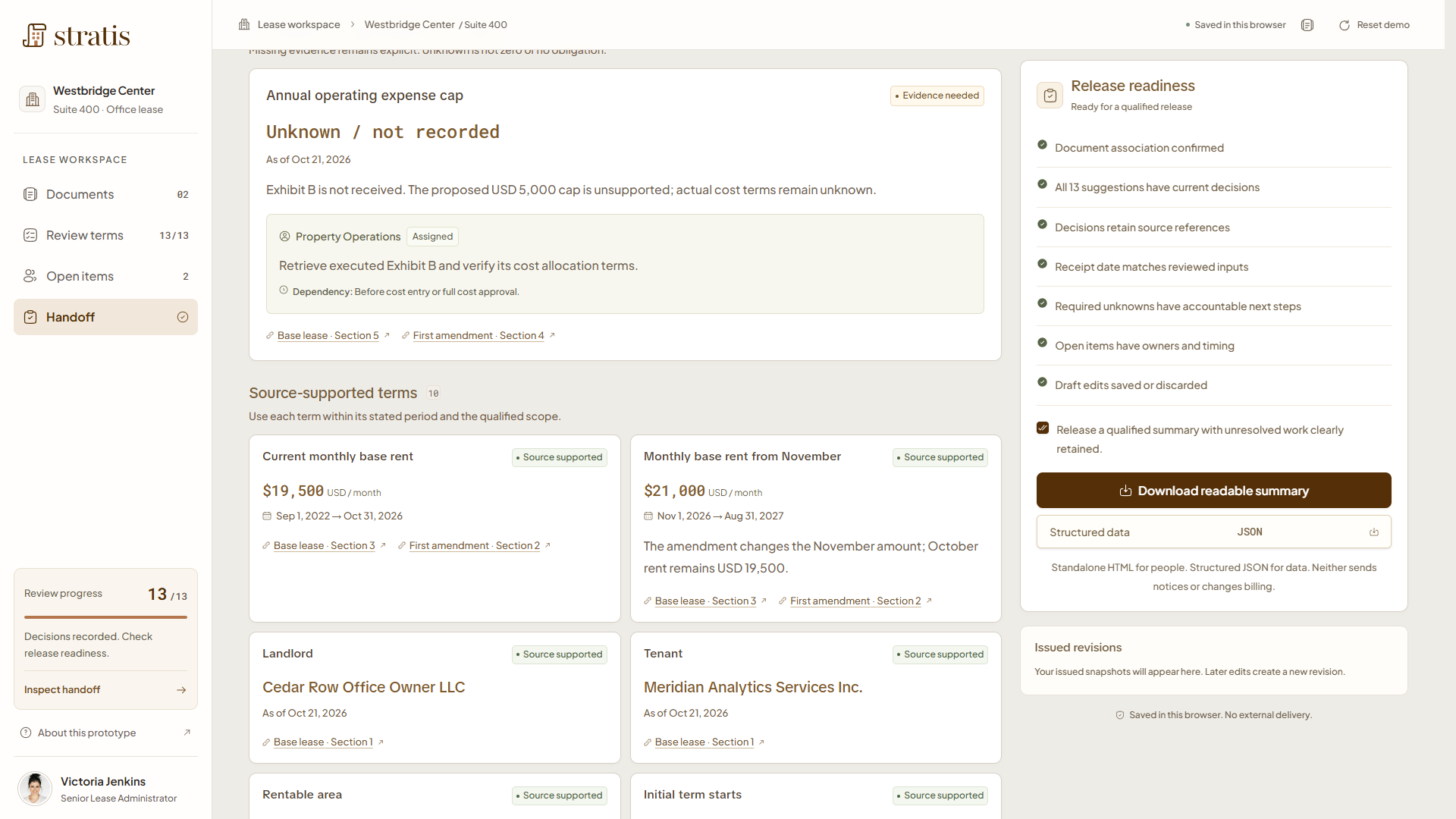
An unsupported expense cap stays unknown and needs an evidence request. An unsupported physical-condition assertion stays not assessed. Neither becomes a verified fact simply because someone finishes reviewing it.
02 / Keep the governing source in view
Risk: a valid base-lease citation could still support the wrong period after an amendment. Related provisions place amendment clauses beside the decision; reviewed input changes reopen dependent dates.
03 / Retain a right without implying eligibility
Risk: “unknown” could erase useful option terms, while “confirmed” could imply conditions were satisfied. Structured fields preserve extension length, conditional rent, and dates alongside separate eligibility checks.
The handoff then groups conditional rights, unknowns with next actions, and source-supported terms around the recipient’s questions.
What I built and checked
- Working interactions: saved review progress, date selection, calculation invalidation, structured conditions, open-item ownership, and versioned HTML/JSON exports.
- Visual system: original branding, warm neutral surfaces, strong reading contrast, and distinct source typography. Semantic states pair color with text.
- Implementation: React, TypeScript, Vite, and browser-local persistence. Suggestions are prepared; AI-assisted development helped turn the workflow into an inspectable prototype.
- Recorded checks: seven model tests, a passing production build, the authored browser workflow, eight sampled widths from 320–1920px, and automated accessibility checks across 16 selected states.
The business case to test next
The opportunity is less reconciliation and coordination effort without losing review quality. The prototype makes that hypothesis testable; commercial value remains unmeasured.
- Planning targetLess review effort
- 25%
- 40 → 30 minutes per amendment.
- Illustrative projectionCapacity returned
- ~17h / mo
- At 100 amendments per month.
Illustrative assumptions, not observed results: (40 − 30) minutes × 100 amendments ÷ 60 ≈ 16.7 hours/month. This is potential capacity, not cash savings or a forecast.
Before making an ROI claim, I would compare equivalent unseen packets, capture independent versus assisted completion, inspect final records, and measure follow-up effort. Faster work only counts if source correctness and unresolved-item visibility hold up.
What I’d carry forward
- Model meaning before polishing status badges. Separating decisions, evidence, and work gave the interface a coherent foundation.
- Design the incomplete endpoint. Useful reviewed information can coexist with missing evidence when scope and ownership stay explicit.
- Capture outcomes during research. Future sessions need final records, assistance notes, timings, and actual viewport dimensions.
The next round would include additional preparers, approvers, and an Accounting recipient. The key question: does a qualified handoff fit their policy and reduce remaining work? The extra structure has to earn the effort it asks of reviewers.
Inspect the work
Explore the artifacts without adding a document viewer to the reading path:
- Readable handoff · PDF example · Structured JSON
- Fictional source packet · Authored evaluator key
- Feedback coding · Decision/evidence map
- Technical checks · Model tests
The overview60 sec read
Make lease changes safe to act on
The brief: help US commercial property lease teams verify changes before billing or handoff. Keep sources, dates, and missing evidence together.
My role: solo product design, practitioner research, branding, and AI-assisted prototype implementation.
From document to dependable handoff
Two practitioner sessions exposed unclear statuses, interrupted source access, and unstructured conditions. I built this workflow:
- 01DocumentsCheck coverage
- 02ReviewDecide with sources
- 03Open itemsAssign next actions
- 04HandoffRetain the limits
The value to test
- Planning targetLess review effort
- 25%
- 40 → 30 min per amendment.
- Illustrative projectionCapacity returned
- ~17h / mo
- At 100 amendments per month.
Assumptions, not measured results: 10 min × 100 ÷ 60 ≈ 16.7 hours/month.
Delivered: working React/TypeScript prototype; seven model tests pass. Screens use fictional data; extraction suggestions are prepared.
Next: validate quality and time with more reviewers. Business impact is unmeasured.
Lesson: a saved decision can still need evidence.
Back to selected work